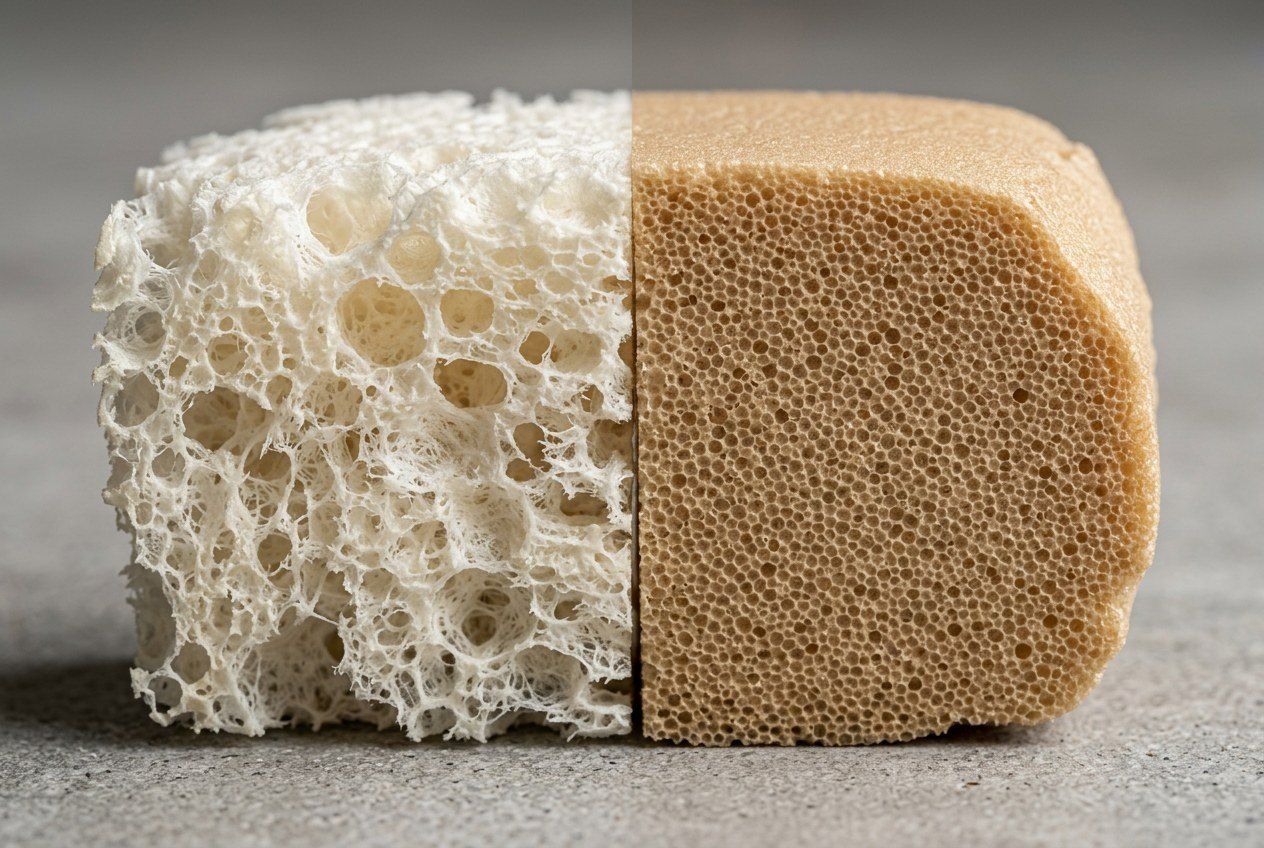
Closed-cell foam packs more thermal resistance into each inch than any other common insulation. That matters most where space is tight, and much less where it is not.
The number, and where it comes from
The U.S. Department of Energy puts closed-cell spray polyurethane foam at roughly R-6 to R-7 per inch, against roughly R-3.5 per inch for open-cell foam. Individual products vary, and the figure that counts for your house is the one printed on the manufacturer's technical data sheet for the exact product being installed, usually measured to ASTM C518 at a mean temperature of 75°F.
The reason for the gap is the cell structure. In closed-cell foam the tiny bubbles are sealed and filled with a blowing agent that conducts heat less readily than air. Open-cell foam has broken cells filled with ordinary air, which is why it is softer, lighter, cheaper per inch and less resistant to heat flow.
Aged R-value versus fresh R-value
Closed-cell foam loses a little of its blowing agent over the first months and years, and its R-value drifts down slightly before stabilizing. Reputable data sheets quote an aged or long-term value for this reason. If one quote lists a noticeably higher per-inch figure than another for similar products, ask whether it is an initial or an aged number. The Federal Trade Commission's R-value Rule requires sellers and installers to state R-values that reflect how the product actually performs, and installers must give you a receipt showing the type, thickness, coverage area and R-value of what went in.
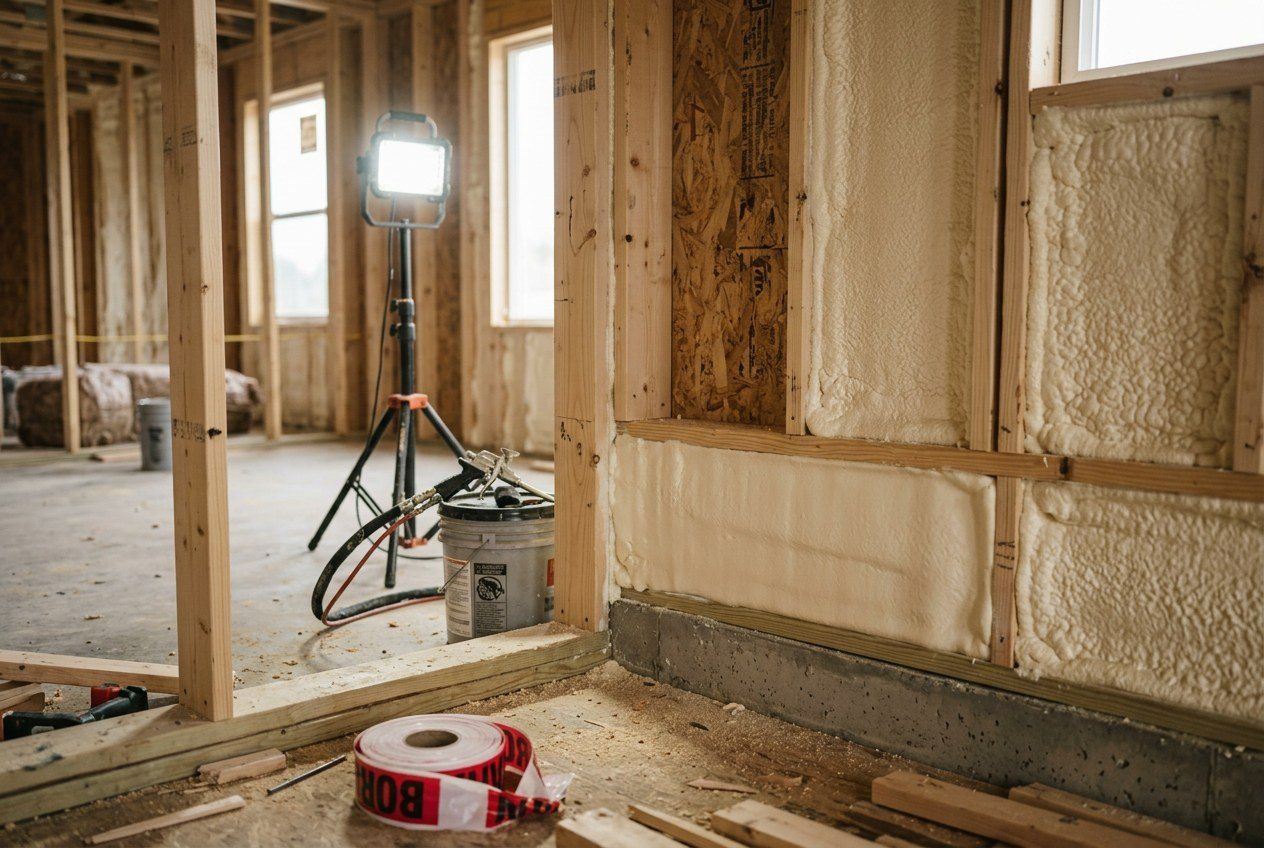
How many inches for common Texas assemblies
Multiply the per-inch value by the installed thickness, then compare that with the code minimum or the target you were given. A few examples, using R-6.5 per inch for closed-cell and R-3.6 for open-cell as round working numbers:
- 2x4 exterior wall (3.5-inch cavity). A full cavity of closed-cell would be about R-22, but most jobs spray 2 to 3 inches, roughly R-13 to R-20. Open-cell filling the cavity gives about R-12 to R-13.
- Roof deck in an unvented attic. To reach R-30 you need about 4.5 to 5 inches of closed-cell or about 8 to 9 inches of open-cell. Roof rafters are often deep enough for either, which is why open-cell dominates Texas roof decks on cost.
- Rim joists and band boards. Two inches of closed-cell, around R-13, both insulates and seals a spot that leaks air in almost every house.
For attic floors in a vented attic, the ENERGY STAR retrofit targets for most of Texas are R-38 to R-49, which is usually more economical to reach with blown cellulose or fiberglass than with foam. Our guide to how much attic insulation you need walks through the depths.
When the extra R per inch is worth paying for
Closed-cell costs more per board foot (one square foot, one inch thick). You are paying for density and for properties beyond R-value, so it earns its price where those properties matter:
- Shallow cavities. Cathedral ceilings, 2x4 walls and knee walls, where there is not room for enough inches of anything else.
- Moisture control. At about 1.5 to 2 inches, closed-cell foam acts as a vapor retarder. That is useful on the underside of floors over crawl spaces and against masonry, and it can be a drawback where an assembly needs to dry in both directions.
- Rigidity. Closed-cell adds stiffness to the framing it bonds to. It is not a substitute for structural design, but it is one reason it is chosen for metal buildings and some coastal work.
Where there is ample depth, as under most Texas roof decks, open-cell usually reaches the same total R-value for less money and handles the air sealing just as well. See open-cell vs. closed-cell spray foam for how the two behave in humid weather.
R-value is not the whole story
A foam job is judged by its thickness, its coverage and the gaps it closes, not by the per-inch figure alone. Foam that is sprayed thin in corners or that pulls away from framing as it cures leaves bypasses that a high label value cannot make up for. The R-value in Texas page explains why air leakage and radiant heat can matter as much as the number, and the spray foam problems guide covers what goes wrong on site.
Two practical checks help. First, ask for the installed thickness in writing for each area and confirm it with a depth gauge while the work is visible. Second, ask which product is being sprayed and request its data sheet, so you can see the per-inch value, the aged value and the manufacturer's re-occupancy time.
Code and fire protection
Foam plastics are combustible. The International Residential Code, which Texas cities adopt in various editions, generally requires spray foam inside living spaces to be covered by a thermal barrier such as half-inch drywall, and requires an ignition barrier or a specially tested coating in many attics and crawl spaces. Your local building department can tell you which edition applies and whether a permit is needed.
Frequently asked questions
What is the R-value of 1 inch of closed-cell spray foam?
Roughly R-6 to R-7, depending on the product. The installer should give you the manufacturer’s figure, ideally the aged (long-term) value.
How many inches of closed-cell foam do I need for R-30?
At about R-6.5 per inch, roughly 4.5 to 5 inches. Check the product data sheet, because the per-inch value varies.
Is closed-cell foam better than open-cell in Texas?
Not automatically. Closed-cell wins where space is tight or moisture control matters; open-cell is usually more economical where there is room for more inches, such as most roof decks.
Does closed-cell foam lose R-value over time?
Slightly, as some blowing agent diffuses out in the first years. Data sheets that quote an aged R-value already account for this.