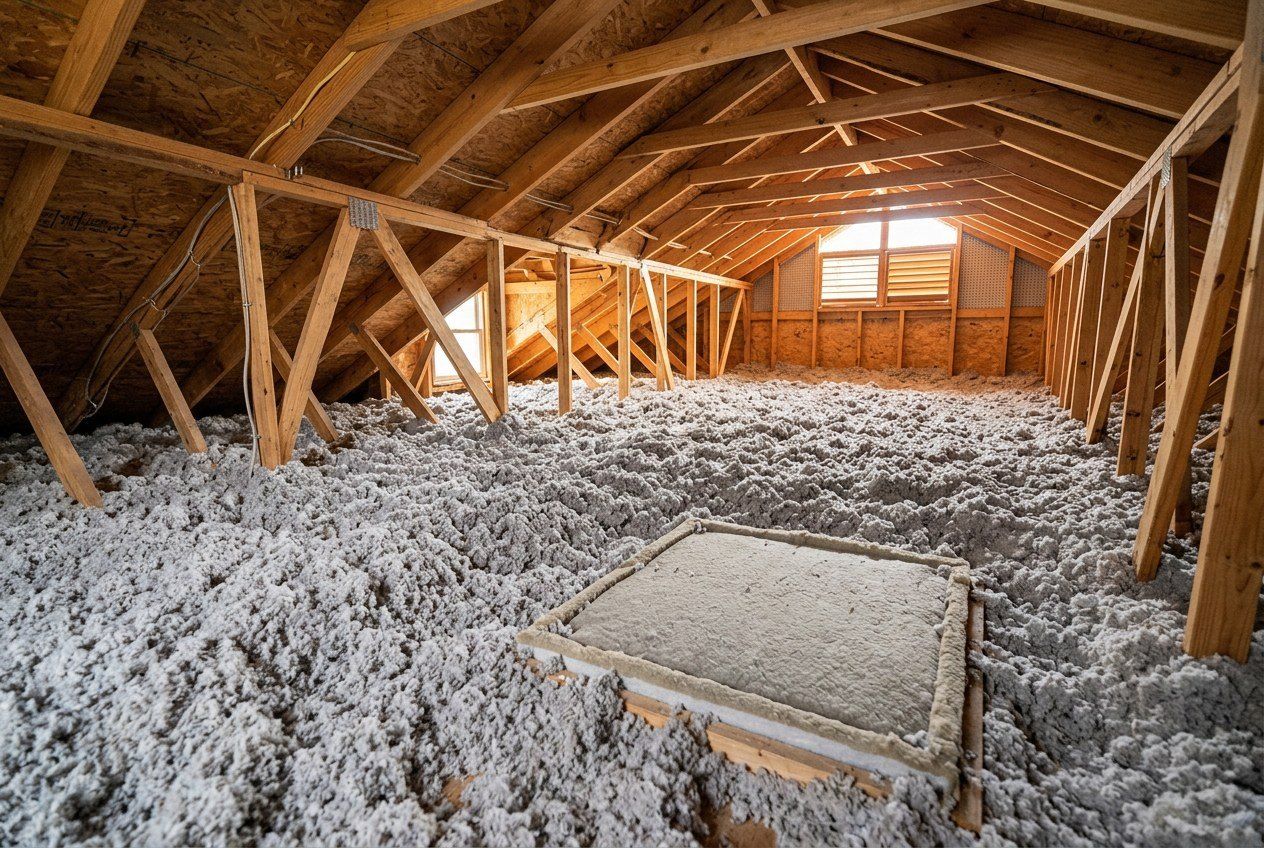
For most of Texas the target for an attic floor is R-38 to R-49. Here is how to tell where you stand and how many inches that takes.
The targets
ENERGY STAR publishes recommended insulation levels for existing homes by climate zone. Most of Texas falls in climate zones 2 and 3 (the Gulf Coast, the Rio Grande Valley, Central Texas and North Texas), and the far northern Panhandle in a colder zone with higher targets. For zones 2 and 3 the recommendations for a vented attic floor are:
- Uninsulated attic: add insulation to reach about R-49.
- Attic with 3 to 4 inches of existing insulation: add about R-38.
In the warmest zone 1 areas, the published figures are R-30 and R-25. Local building codes set minimums for new construction and major work; Texas cities adopt their own editions of the International Energy Conservation Code, so check with your city if you need a permit.
How to measure what you have
- On a cool morning, go into the attic with a flashlight, a tape measure and a dust mask. Step only on joists or boards.
- Measure the depth of insulation in several places, including near the eaves and around the hatch, where it is usually thinnest.
- Identify the material: fluffy pink, yellow or white fibers are fiberglass; gray, paper-like fill is cellulose; gray-brown pebbles may be vermiculite, which should be left undisturbed until tested for asbestos.
- Note whether the tops of the ceiling joists are visible. ENERGY STAR's rule of thumb: if the insulation is level with or below the joists, you probably need more.
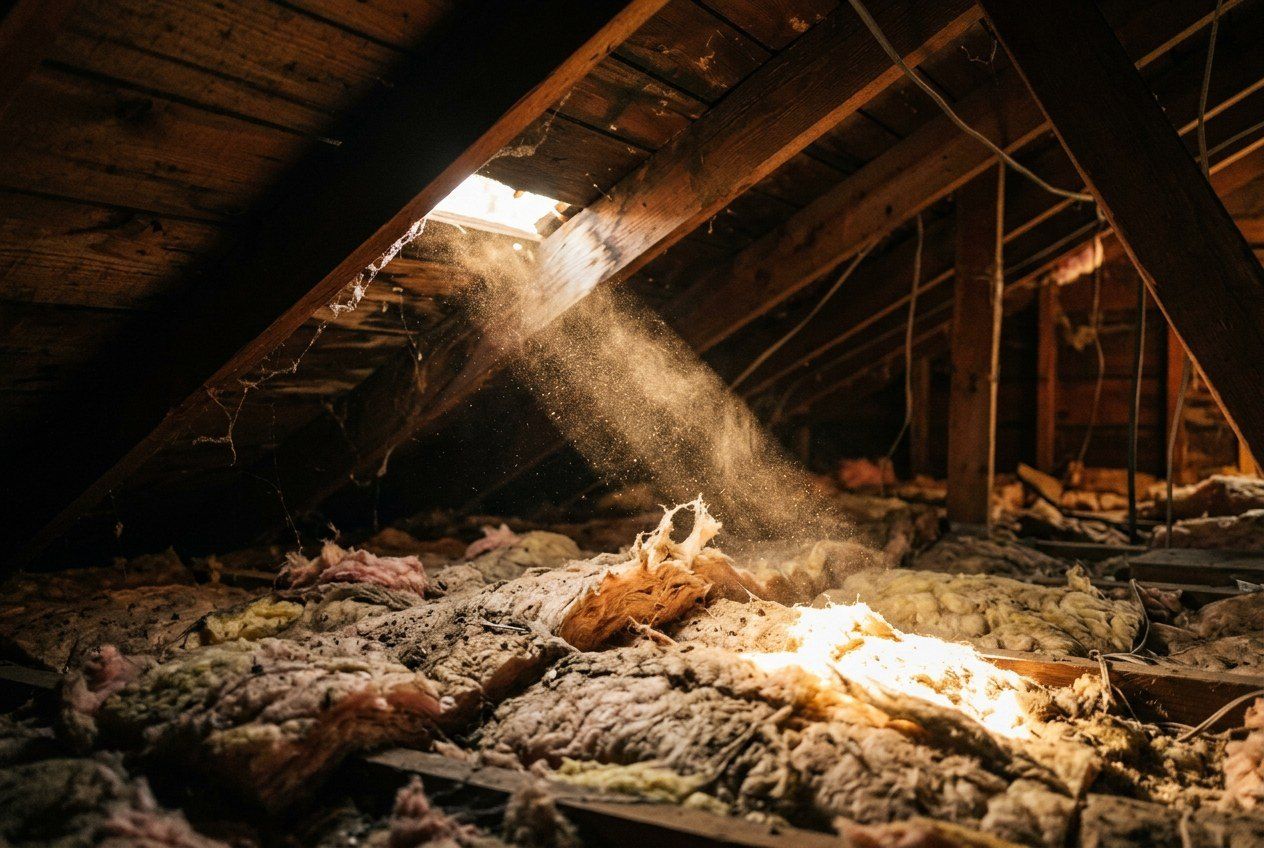
Converting R-value to inches
Depth depends on the material. Using the Department of Energy's typical ranges for loose fill, roughly R-2.2 to R-2.9 per inch for fiberglass and R-3.2 to R-3.8 for cellulose, the approximate settled depths are:
- R-30: about 8 to 9.5 inches of cellulose, or 10.5 to 13.5 inches of fiberglass.
- R-38: about 10 to 12 inches of cellulose, or 13 to 17 inches of fiberglass.
- R-49: about 13 to 15 inches of cellulose, or 17 to 22 inches of fiberglass.
The bag's coverage chart gives the exact figure for that product: the minimum settled thickness and the number of bags per 1,000 square feet for each R-value. Old insulation counts toward the total if it is dry, clean and not compacted; estimate its R-value from its depth and type and add the difference.
Where the depth usually falls short
- At the eaves, where the roof comes down to the top plate. Install baffles to keep soffit vents open, then fill as deeply as the space allows.
- Over the hatch. Glue rigid foam or a batt to the back of the hatch and weatherstrip the frame.
- Under walkways and around the air handler, where boards were laid on the joists.
- Where it was disturbed by cable, satellite or HVAC work.
Does more always help?
Each added inch saves less than the one before, because heat flow drops in proportion to 1/R. Going from R-11 to R-30 makes a large difference; going from R-38 to R-60 makes a small one in a Texas climate. Beyond the targets, money is usually better spent on air sealing, duct sealing and, in a hot attic, a radiant barrier. The Department of Energy notes that radiant barriers are more effective in hot climates, especially when ductwork runs through the attic.
If the ducts are in the attic
Many Texas homes have their air handler and ducts in a vented attic, where summer air can exceed 130°F. Insulation on the attic floor does nothing for ducts lying on top of it. Seal and insulate the ducts, bury them in loose fill where practical, or consider moving the insulation to the roofline to bring them inside the conditioned space, as described in vented vs. unvented attics.
Next steps: choose a material with cellulose vs. fiberglass, then a method with blown-in vs. batts.
A worked example
Say a 1990s house in Central Texas has about 4 inches of old fiberglass that has settled and thinned at the eaves, roughly R-10 to R-11. ENERGY STAR's recommendation for an attic with 3 to 4 inches is to add about R-38. Using cellulose at around R-3.5 per inch, that is roughly 11 inches on top of the old layer, or about 14 to 15 inches of fiberglass. The coverage chart on the bags turns that into a bag count for the attic's square footage.
Frequently asked questions
How much attic insulation is recommended in Texas?
For most of Texas (climate zones 2 and 3), ENERGY STAR recommends about R-49 for an uninsulated attic and adding about R-38 where there are already 3 to 4 inches.
How many inches is R-38?
Roughly 10 to 12 inches of cellulose or 13 to 17 inches of loose-fill fiberglass. The bag’s coverage chart gives the exact settled thickness.
Is R-30 enough for a Texas attic?
It meets older codes and the zone 1 recommendation, but ENERGY STAR’s targets for most of Texas are higher. Adding more is usually inexpensive with loose fill.
Can you have too much attic insulation?
Not in a harmful sense, as long as soffit vents stay open and clearances around lights and flues are kept. The savings simply shrink beyond the recommended levels.